

26 February 2026
Why the “doctors charge too much” narrative gets it exactly backwards – and what’s really happening to private practice in South Africa.
There’s a narrative that has become almost conventional wisdom in this country: private healthcare is expensive because doctors charge too much. It gets repeated in the media, in policy circles, and around dinner tables.
I’ve spent over a decade working in the backend of private medical practices — the billing, the claims, the contracts, the shortfalls. Here is what I actually see.
The real story is a slow squeeze, not a windfall
Most private practitioners are not getting richer. In real terms, many are earning less today than they were five or ten years ago — not because they’ve lost patients, but because the gap between what medical schemes reimburse and what it costs to run a modern practice keeps widening, quietly and relentlessly.
It works like this: scheme reimbursement increases tend to be anchored close to CPI. Practice costs — staff wages, rent, electricity, compliance, technology, malpractice risk — don’t follow CPI. They follow their own trajectory, often running well ahead of it.
Nobody writes the headline: “Doctor earns 15% less in real terms than a decade ago.”* But that story is playing out in practices across South Africa right now.
What “Scheme Rate” actually means — and what it doesn’t
The phrase “doctors charging above medical aid rates” gets used as though scheme rates represent a fair, objective price for medical care. They don’t.
Scheme rates are a reimbursement reference point built into a benefit product. They are not cost-based prices. South Africa has been operating without a proper tariff framework for years — what we have is a fragmented, scheme-by-scheme, option-by-option patchwork, the result of years of regulatory uncertainty and bilateral negotiation.
When costs rise but the benchmark doesn’t move meaningfully, someone absorbs the difference. Usually it’s the doctor first, and then — inevitably — the patient.
Let’s make it concrete:
The Gynaecologist example
Abstract arguments about tariffs and CPI can feel distant. So let’s look at a real example.
Using actual billing data from an independent practice (January–February 2026), the average scheme reimbursement for a vaginal delivery — covering all obstetric care from the onset of labour through to the six-week post-partum visit — is ±R5,419 per case (billing code 2614). Under a network contract arrangement, the same case averages ±R8,905.
The blended real-world average across a typical mixed practice works out to ±R7,430 per delivery. (see Chart below)

Now consider the cost side. Obstetrics sits at the extreme end of the medical indemnity spectrum — it is one of the highest-risk specialties in the world for malpractice claims, and premiums reflect that reality. According to the South African Society of Obstetricians and Gynaecologists (SASOG), indemnity cover for obstetricians has risen to well over R1 million per annum — with some practitioners in private practice reporting premiums of R1.3 million per annum and higher.
We readily acknowledge that obstetrics represents the most extreme end of the indemnity cost spectrum. A GP or physician faces a very different picture. But the underlying dynamic — scheme reimbursements that don’t keep pace with real practice costs — plays out across specialties, not just in obstetrics. The numbers are smaller; the squeeze is the same.
Patients pay more. Doctors get less. The gap goes somewhere.
Here’s the piece of the puzzle that rarely gets mentioned: medical scheme contributions have risen consistently year on year. Members are paying more. Yet in real terms, scheme reimbursements to doctors have not kept pace.
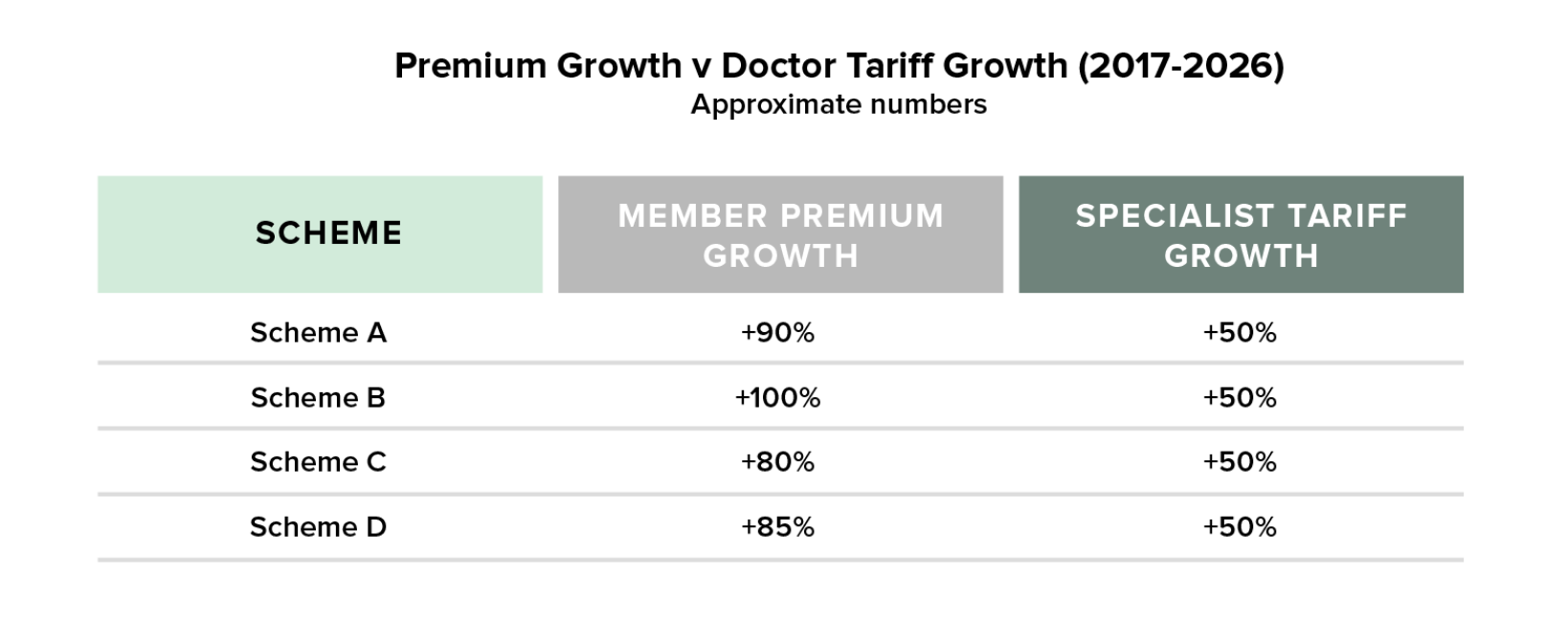
The numbers tell the story plainly. Across four major medical schemes, member premium growth between 2017 and 2026 ranged from ±80% to ±100%. Over the same period, specialist tariff growth across all four schemes was a uniform ±50%. Members paid nearly double. Doctors received half of that growth. The gap didn’t happen once — it happened every year, across every scheme, for a decade.
The money isn’t disappearing. It’s being absorbed elsewhere in the system — in administration, in managed care layers, in medical scheme administrators, and in the very healthy financial results that the large private hospital groups publish each year.
It’s not “IN” or “OUT” — it’s far more complex
One of the persistent myths is that doctors simply choose to accept scheme rates or walk away. The reality is far messier. Most practitioners end up with a patchwork of arrangements: contracted with some schemes and options, outside networks for others, in preferred provider arrangements here, not there.
As the economics tighten, the rational response isn’t recklessness — it’s selectivity. Doctors choose the networks and contracts where the combination of rate, volume and administrative burden still makes commercial sense. The ones that don’t make sense, they step back from.
The result, over time, is a gradual contraction of open, accessible independent practice. That’s bad for patients. But it’s a consequence, not a cause.
Who the narrative conveniently ignores
Make no mistake — the affordability crisis for patients is real and it deserves attention. But a narrative that points the finger exclusively at doctors — while largely ignoring scheme contribution increases, benefit design complexity, the profits of medical scheme administrators, and hospital group profitability — isn’t a serious analysis. It’s a convenient one.
Private practitioners have no collective voice, no pricing power, and no structural protection. They trained for a decade. They carry enormous personal liability. They run small businesses in an increasingly hostile regulatory and commercial environment.
Easy to blame. Hard to organise. Increasingly difficult to sustain.
Conclusion
Patients are right to want affordable, accessible healthcare.
But if we want to fix what’s broken, we need an honest conversation about where the pressure actually sits — and who is being asked to absorb it year after year.
What would help: a transparent, evidence-based measure of practice cost inflation that goes beyond CPI; plain-language benefit communication so patients understand their cover before they need to use it; and a broader public conversation that holds the whole value chain accountable — schemes, administrators, hospital groups, and practitioners alike.
The doctors who keep private healthcare running deserve better than a narrative built on a misunderstanding of how the system works.
Need help?
If you want a clearer picture of how the economics of your practice are shifting — and what you can do about it — we’d be happy to talk.
Werner du Plessis is the Chairman of Medvest Capital, a practice management and administration company that has worked with private medical practitioners across South Africa since 2013.




Contact us
Want to talk about whether our model could work for you? To start a conversation, please fill out the form.
Your information is valuable to us, and we’re committed to protecting your privacy. Please review our privacy policy for more information on how we handle your personal data.
