

2 July 2025
Starting Point
A Two-Perspective Table
This article uses Discovery Health as an example to address a broader dilemma: how should doctors determine whether or not to contract with a medical scheme?
We focus on Discovery simply because their structure allows us to model the situation with unusual clarity—but the underlying logic applies across schemes.
The most practical way to approach this dilemma is to distinguish between two perspectives:
- The patient’s (what plan they are on)
- The doctor’s (what contract they’ve chosen)
We’ve integrated these perspectives into a clear, two-axis table that cross-references the doctor’s available contract options with patient plan types (see Table 1). Then we combine the details in a comprehensive matrix (see Table 2). The result is a matrix that makes visible what has long been unclear: how contract decisions interact with patient plan types.
Now, let’s first clarify which plans and agreements are available to each:
TABLE 1:
| Doctors | Patients |
|---|---|
| No contract | Executive Plan |
| Premier A | Classic Plan |
| Premier B | Essential / Coastal Plans |
| Classic Agreement |
In the table below we show a matrix combining the details of the plans and agreements from two perspectives.
DR = Discovery Rate
DSP = Designated Service Provider
TABLE 2:

Defining Key Variables
To decide which contract is best, the doctor needs to step outside the plan structure and ask: what is the real-world financial logic behind this system?
We propose that two variables dominate all others:
Collectability
Collectability refers to the doctor’s ability to charge and recover more than the Discovery Health Rate (DHR). It’s influenced by:
We define collectability numerically as:
- High: >80% of patients pay the full amount (via GAP or top-up)
- Medium: 50–80%
- Low: <50%
PMB Frequency
PMB frequency measures how often the doctor’s claims fall under Prescribed Minimum Benefits (PMBs), tightly regulated conditions that require schemes to pay.
Important clarification: PMB conditions become PMB cases only when they require hospital admission or similar regulated events. Only then does the scheme consistently pay at 300%, even if the doctor isn’t a DSP.
We define PMB frequency as:
- High: >50% of cases are PMBs
- Medium: 25–50%
- Low: <25%
The Decision Matrix
Choosing the Optimal Contract
The table shows the interaction. It does not show the answer. To decide which contract is best, the doctor needs to step outside the plan structure and ask: what is the real-world financial logic behind this system?
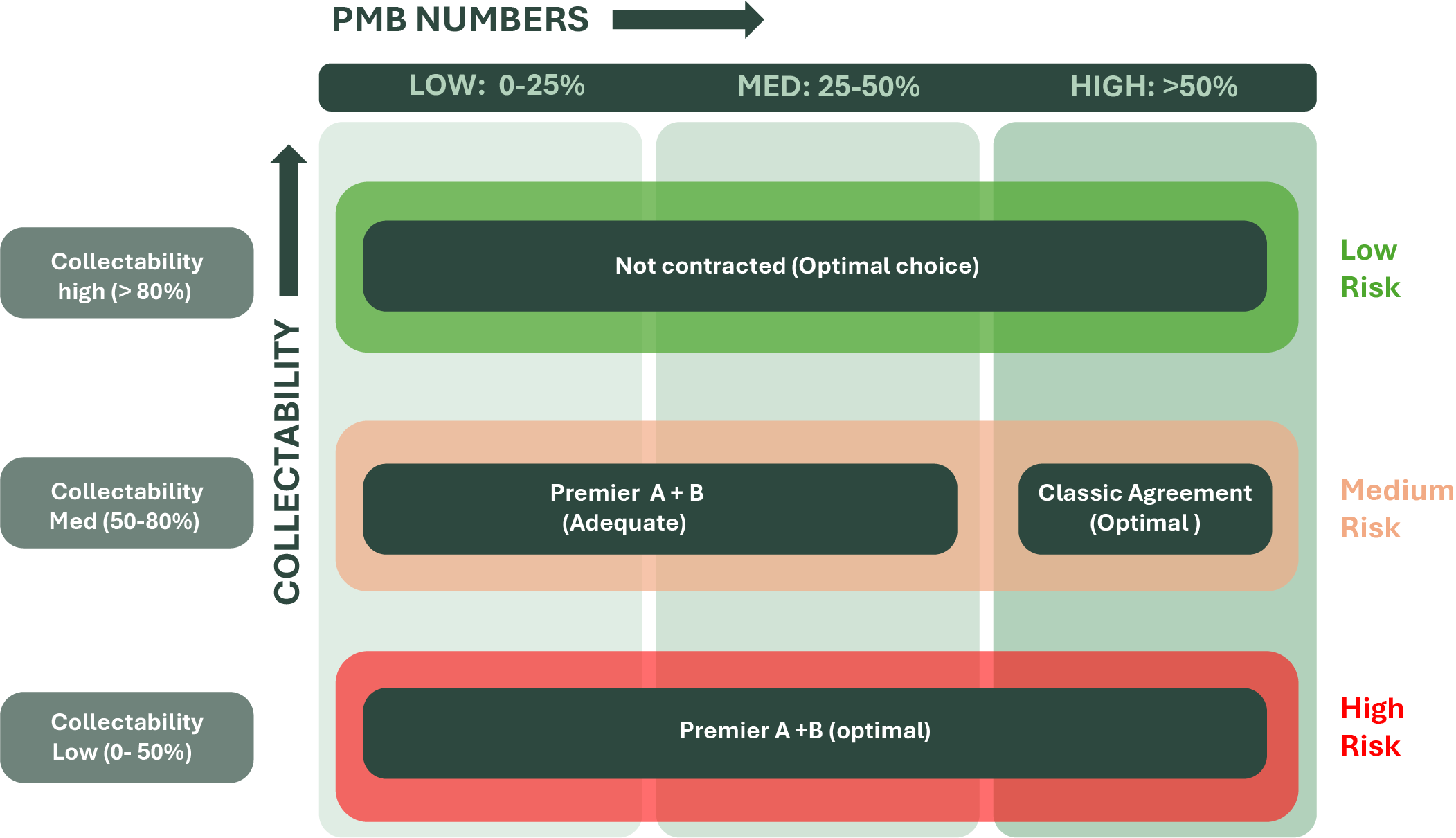
We shall use these two variables to build a grid — a 3×3 matrix — that shows where each contract option is optimal or adequate depending on the doctor’s environment.
The Grid: Where Each Contract Belongs
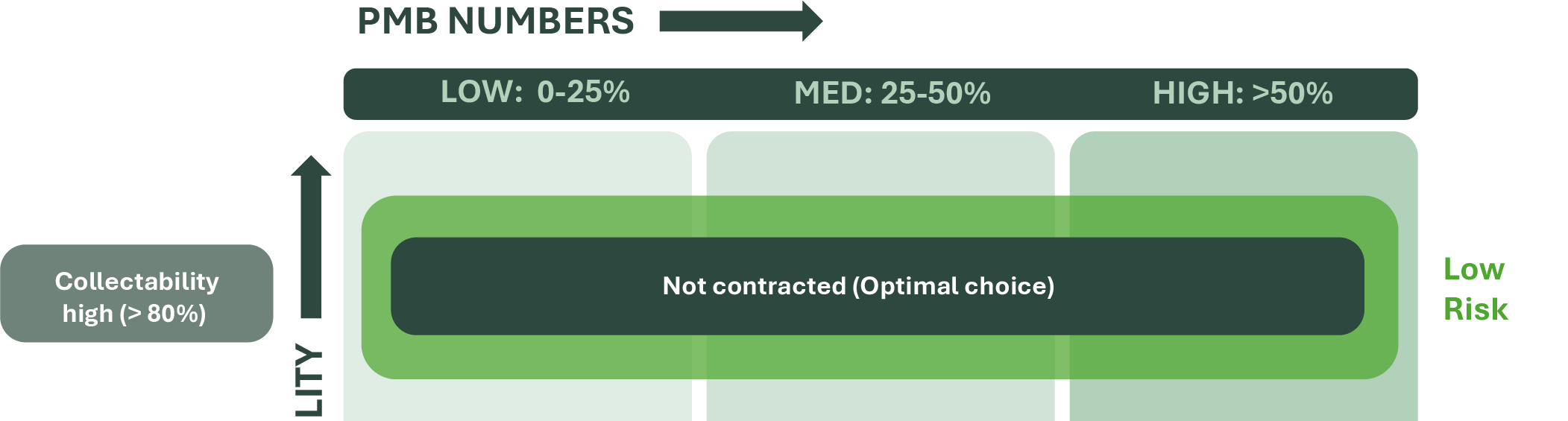
High Collectability
With Any PMB Frequency → Best Choice: Not Contracted (Optimal)
Motivation
When collectability is high, the practice reliably charges 300% of DHR, either via GAP cover or direct patient payment.
- Retain billing control
- Avoid administrative overhead
- PMBs covered without DSP status
- No clawbacks or imposed tariffs
This choice suits specialists in affluent urban areas serving well-covered patients.
Medium Collectability

With Low to Medium Numbers of PMBs → Premier A and B (Adequate Cover)
Let us recall the grid in table 1:

- Patients occasionally pay top-ups, but not reliably. With low PMB exposure, DSP status matters less. These agreements offer stability without balance billing.
- The choice between Premier A and B hinges on the ratio of in-hospital to out-of-hospital procedures:
- Premier A (162% out-of-hospital, 137% in-hospital) suits consultative work.
- Premier B (higher rates for in-hospital) suits hospital-based procedures.
- This scenario suits mixed-income areas and practices needing predictability and margin protection.
With High PMBs – Best Choice → Classic Agreement (Optimal)
- High PMB frequency necessitates DSP status to avoiddelays in claim adjudication.
- Pays 217% in-hospital (Classic Plans Only), 100% out-of-hospital (balance billing allowed)
- Provides security with reduced risk in high-PMB environments
- Retains some billing flexibility
Low Collectability

For All PMB Levels – Best Choice → Premier A or Premier B (Optimal)
Balance billing is rarely viable, so risk management is crucial.
• Predictable reimbursement
• Accept less potential upside for stability
Ideal for lower-income areas prioritizing administrative simplicity.
Case Example: Dr Miller in Paarl
Dr Miller is an orthopaedic surgeon performing joint replacements in a private hospital in Paarl . His patients are largely on Executive and Classic plans, with GAP cover. His PMB rate is moderate (around 40%).
Best option: Not Contracted — Miller charges 300% DHR, gets paid via GAP, and avoids admin friction. PMBs pay in full, so he doesn’t need DSP status.
Conclusion
We’ve simplified a complex decision-making process with clear logic. While the table and matrix reflect Discovery’s structure, the underlying framework—distinguishing collectability from PMB exposure—applies universally across medical schemes.
This approach is not about gaming the system; it’s about understanding and navigating it effectively.
Need help?
If you need a better understanding or deeper analysis of your practice, don’t hesitate to give us a call.




Contact us
Want to talk about whether our model could work for you? To start a conversation, please fill out the form.
Your information is valuable to us, and we’re committed to protecting your privacy. Please review our privacy policy for more information on how we handle your personal data.
